Quick Answer
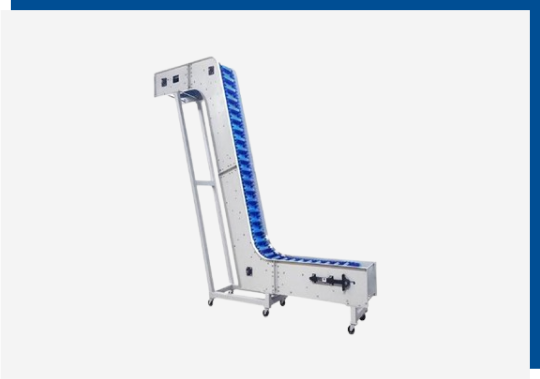
A Z-conveyor moves product between levels within a single compact footprint, so a plant can connect lines on different floors or mezzanines without running a long flat conveyor across the building. In food processing, that saves floor space, keeps product flowing at a steady rate, and reduces manual handling. CHL Systems designs and installs custom Z-conveyors for bulk and packaged goods, sized to each facility’s layout.
Most food plants run out of room long before they run out of ideas. A line that looks fine on a drawing often ends up with packaging on one side of a wall and mixing on the other, and the product path doubles back on itself. Z-conveyors are one of the simpler ways to fix that. They move material up or down without tearing up the layout, and they’ve become a common sight in facilities that need to change height without adding much floor space.
What a Z-Conveyor Actually Does
The name comes from the shape of the path. Product enters at one level, travels through a series of belt sections that carry it up or down, and exits at another level. Instead of a long ramp or a separate elevator, a single footprint handles the change in height. For dry goods, snacks, and packaged items, that means product can keep moving between equipment on different levels while operators stay where they need to be.
Where the Efficiency Comes From
Efficiency in a plant rarely comes from one big change. It usually shows up as a pile of small ones: fewer manual lifts, less waiting at transfer points, and no product sitting around because a conveyor backed up. A Z-conveyor helps on each of those fronts.
It covers vertical distance in a compact frame, so it can connect equipment that would otherwise need a longer run or an extra handling step. Fewer transfers mean fewer chances for product to get dropped, crushed, or left waiting.
Smooth transitions matter as well. Bulk material and packaged goods behave differently on a belt, and a poorly set up lift can cause spillage, jamming, or uneven flow. A well-configured Z-conveyor keeps product moving at a steady rate, which makes downstream equipment easier to keep fed and cuts down on the stop-and-start cycles that eat into output.
Plants that want to find these bottlenecks often start with a review of their overall flow, and CHL’s conveyance and process improvement work is built around exactly that kind of review.
Sanitation Is Part of the Design
In food processing, a conveyor that is hard to clean is a problem before it is a productivity issue. Stainless-steel frames that can handle washdown are the starting point, but the details matter too. How the frame is joined, how reachable the belt and drive components are, and whether crews can get to the spots where residue collects all affect how well the unit holds up to a sanitation schedule.
Sanitary Z-conveyors are designed with those points in mind, so cleaning crews can work through them without taking the whole line apart. The same attention to hygiene runs through the rest of CHL’s equipment lineup.
Maintenance ties into the same idea. Components that are easy to reach get inspected sooner and replaced before they fail. That habit alone can prevent a lot of unplanned downtime.
Fitting a Z-Conveyor Into an Existing Line
Few plants start from a blank sheet. Most are adding capacity, moving equipment around, or trying to get a new packaging line to work with an older processing area. The useful question is less “which conveyor is best” and more “what fits here, and what does the product need to do once it arrives.”
Height, footprint, product type, throughput, and how the unit connects to equipment upstream and downstream all shape the answer. Custom configuration is often what separates a unit that works on paper from one that works on the floor.
Z-conveyors also pair well with other equipment. Screw conveyors might feed material into the lower inlet, for example, or a hopper takeaway might handle the step before it. The goal is a path that makes sense from start to finish, rather than a lift bolted onto a line that wasn’t planned for it.
If the run is mostly horizontal with only a small change in height, a unit like the FT-2000 may be a better fit.
Working With a Design and Build Team
When a plant considers a Z-conveyor, the most useful first step is a conversation about the actual layout and product. A good supplier asks how much material moves per hour, what the product is like, what cleaning routine the line follows, and where the unit has to sit.
From there, the design can account for the things that cause trouble later, such as belt tracking, access for cleaning, and how the unit ties into controls.
CHL Systems designs, builds, and installs food processing equipment from its base in Souderton, Pennsylvania. Its Z-conveyors are customized to each application, and they can be planned as one part of a larger project through its design and build solutions rather than as a stand-alone purchase.
Frequently Asked Questions
What is a Z-conveyor used for?
A Z-conveyor moves bulk or packaged products between levels within a facility. Food plants use them to connect lines on different floors or to move product through a multi-level layout without a long ramp.
What makes a Z-conveyor sanitary?
Sanitary Z-conveyors use stainless-steel construction that can handle washdown, along with components that are accessible for cleaning and inspection. The exact features depend on the configuration, so review them with the manufacturer against your product and cleaning routine.
Can a Z-conveyor be customized?
Yes. CHL Systems designs Z-conveyors around each facility’s product, footprint, and throughput, and can configure them to work with existing equipment.
What products can Z-conveyors handle?
They are used for dry goods, snacks, other packaged items, and bulk materials. Product behavior affects belt choice and configuration, so a site review helps confirm the fit.
How do I know if a Z-conveyor is right for my plant?
Start with your layout, your product type, how much material moves per hour, and where the unit needs to connect. You can reach out to the CHL Systems team to talk through those details.
Conclusion
Integrating a Z-conveyor into your food processing line offers a seamless solution for maximizing vertical space, protecting product integrity, and maintaining high throughput. By combining space-saving efficiency with sanitary design features tailored for food safety, Z-conveyors help eliminate bottlenecks while streamlining your material handling workflow.