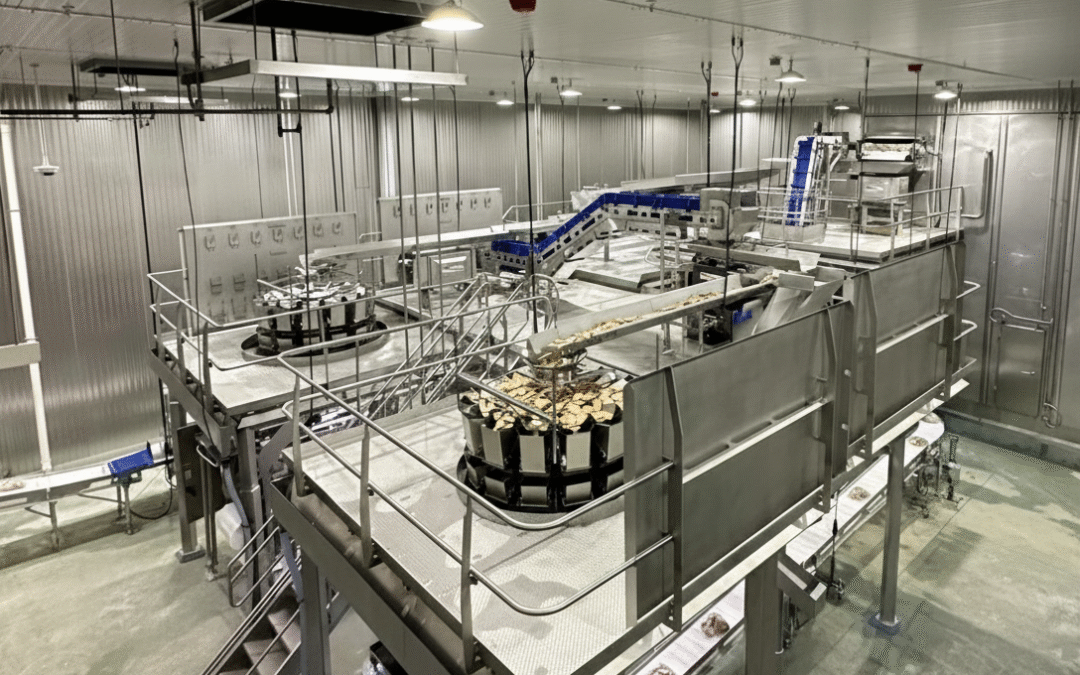
In today’s competitive food manufacturing landscape, operational efficiency and food safety aren’t just priorities—they’re survival requirements. With increasing production demands and tight regulatory standards, food manufacturers are discovering that traditional ground-level layouts can’t keep pace with modern requirements. As a result, they are turning to elevated sanitary platforms, a game-changing approach that’s transforming how food processing facilities operate.
From pet food manufacturing to protein processing, companies are literally raising their production capabilities to new heights. Discover how to elevate your production with these 5 compelling reasons to incorporate elevated sanitary platforms into your food manufacturing facility.
1. Maximized Facility Footprint
Double your usable production space
Building vertically transforms how you utilize existing facility space. Elevated platforms effectively create two levels of operational area within your current building envelope, maximizing return on your real estate investment.
The space beneath platforms remains accessible for utilities, storage, or support functions, while the elevated level handles primary processing. This approach is particularly valuable for facilities facing expansion constraints or high real estate costs.
Custom platform design ensures optimal use of available height while maintaining required clearances for equipment access and maintenance.
The result: Increased production capacity without facility expansion costs.
2. Superior Sanitation and Food Safety
Design out contamination risks before they occur
Traditional ground-level installations create cleaning challenges that elevated platforms eliminate. With processing equipment mounted on custom sanitary platforms, cleaning crews gain complete access underneath and around all equipment.
Integrated drainage systems direct wash water and cleaning solutions away from production areas, preventing standing water that harbors bacteria. Welded construction eliminates bolt holes and crevices where contaminants can hide, while sloped surfaces ensure complete drainage.
The elevated design also separates production activities from floor-level traffic, reducing cross-contamination risks and supporting your HACCP protocols.
The result: Enhanced food safety compliance and reduced contamination risks.
3. Gravity-Powered Production Flow
Eliminate bottlenecks with natural product movement
Elevated platforms harness gravity to create seamless product flow between processing stages. Instead of relying on complex conveyor systems or manual material handling, your ingredients and products move naturally from one process to the next.
This gravity-assisted approach reduces mechanical failure points, minimizes energy consumption, and creates more reliable production timing. When your mixing, screening, and packaging equipment operates at different elevations, product flows efficiently without additional pumping or conveying equipment.
The result: Reduced operational costs and more consistent production throughput.
4. Optimized Maintenance Access
Reduce downtime with engineered accessibility
Elevated platforms enable strategic positioning of maintenance access points at optimal working heights. Instead of technicians working in cramped conditions or requiring specialized equipment to reach elevated components, maintenance platforms provide safe, ergonomic access to all equipment.
Integrated trolley systems allow heavy components to be safely moved for service, while removable platform sections provide access for major maintenance activities. This planned accessibility reduces maintenance time and improves safety for your technical teams.
Multiple access levels also support concurrent maintenance and production activities, minimizing production interruptions.
The result: Reduced maintenance costs and minimized production downtime.
5. Future-Proof Flexibility
Adapt to changing production requirements
Custom sanitary platforms are designed with modification in mind. Modular construction allows for equipment changes, capacity increases, or process modifications without complete facility reconstruction.
Pre-engineered mounting points accommodate future equipment additions, while integrated utility routing supports new electrical, pneumatic, or process connections. This flexibility protects your investment as production requirements evolve.
The robust structural design also supports equipment upgrades that may be heavier or larger than original installations, extending the useful life of your platform investment.
The result: Long-term adaptability and protected capital investment.
Engineering Your Elevated Future
When ground-level limitations are holding back your production potential, it’s time to rise above the constraints with elevated sanitary platforms. Your elevated platform isn’t just supporting equipment—it’s supporting your company’s future growth.
The key to successful platform implementation lies in custom design that addresses your specific production requirements, facility constraints, and future growth plans. Working with an experienced platform designer like CHL Systems ensures your elevated platform delivers both immediate operational benefits and long-term strategic value.
Ready to elevate your production capabilities? Contact our platform design team to discuss how custom sanitary platforms can transform your manufacturing operations.